
Presented by economx

AI IS NOW

AI Summit Budapest 2026
September 7–8Városliget
2 days3 venues
10 stages300+ speakers
Overview

When the tool becomes
a collaborative partner

By 2026, artificial intelligence is no longer a vision of the future but a business and social reality. What are the year's most important AI breakthroughs? Who is shaping development, and which industries are gaining an edge? How are work, decision-making, and competition changing? Don't just watch the change: understand it, shape it, and find your own opportunities within it at AI Summit 2026.

0thedition in Budapest
0parallel tracks
0+local and international speakers
0attendees in Városliget
0days in Városliget
Featured topics

One conference. Multiple Mini Summits.
Which one will you choose?

Full programme
AI Trends 2026

When artificial intelligence gets to work

AI has stepped out of the world of experimental projects and entered the most important processes of corporate operations: it supports decisions, serves customers, creates content, analyzes data, automates workflows, and is becoming a true digital colleague in more and more areas. After generative AI, the era of Agentic AI has arrived: autonomous systems that no longer simply respond, but plan, execute, and deliver results. The AI Trends 2026 section shows how business, work, creativity, and technological competition are being transformed in an age where artificial intelligence is no longer just a tool, but a strategic force. Topics will include return on investment, scalable AI solutions, new corporate operating models, data security, regulation, human-machine collaboration, and who the real winners of the AI era will be. Boldly, quickly, intelligently – if you use AI this way, you can build a competitive advantage; if you hesitate, you will fall behind!
AI Society

Who controls the future?

Everyone can already feel that artificial intelligence is no longer just a technological issue. It is now about community, society, power, and ultimately about you, the person using it. AI is present in our workplaces, schools, news, public services, healthcare, and in the background of our everyday decisions. It helps, accelerates, analyzes, suggests – and meanwhile, almost invisibly redraws what it means to know, work, create, decide, and take responsibility. The AI and Society section focuses on what truly matters behind technological breakthroughs: us. It explores how we will live in the coming decades, who the major winners and losers of this transformation will be, and how younger generations can find opportunities in a transitional era where the benefits of technology may still be less visible than its negative impact on communities. What kind of society are we building with AI, and what will remain for us humans in this new world?

AI Space and Defence

Where the algorithm becomes a strategic force

In 2026, AI and autonomous systems are already an operational reality. Satellites, drones, sensor networks, and cyber defence platforms are being connected to interpret the world's most critical situations faster and more accurately. Today, AI no longer simply analyzes data: it supports decisions, predicts threats, controls systems, and creates new defence capabilities. The AI Space and Defence section examines how AI is transforming the space industry, how it supports space research, and how it is rewriting security policy and the operations of modern defence. Topics will include autonomous systems, drones, satellite data analysis, cyber defence, strategic sovereignty, and the question of human control. One of the key questions of 2026 is how AI can be used quickly, responsibly, and safely in defence technology in an increasingly unpredictable world, where technological superiority now depends on decision-making speed and reliable data.

AI and Cybersecurity

We need to be faster than the attackers

Today, no one can afford to treat cybersecurity as a background task. In the digital space, defence has become a business, governmental, and social challenge. In 2026, attacks are faster, more automated, and harder to detect: artificial intelligence strengthens defensive systems while also giving attackers new tools. Phishing, deepfakes, ransomware, supply chain vulnerabilities, the protection of critical infrastructure, and human error – today's risks form an interconnected map of threats. The cybersecurity section, organized in cooperation with ITBN, examines how we can prepare for a digital environment where AI accelerates both attack and defence. Topics will include incident response, data protection, corporate resilience, regulation, and leadership responsibility. The key question of 2026 is whether we can break out of the vicious cycle of merely reacting to attacks.

AI and Economy

When the algorithm moves the money

The financial sector is one of the biggest winners of the AI revolution. In 2026, artificial intelligence already produces faster analyses, supports investment decisions in real time, detects fraud, personalizes banking services, and redefines risk management. As algorithms prepare more and more decisions, transparency, trust, and regulatory compliance become increasingly important. The AI and Finance section presents how AI is transforming the operations of banks, insurers, fintech companies, and capital market players. Topics will include intelligent investments, digital payments, AI-based customer experience, protection against financial fraud, and the future financial ecosystem. One of this year's major questions is: if AI controls transactions, if machines sell and buy investment assets, and if compliance automatically filters suspicious transfers, what tasks remain for banking experts?

AI and Education

We need to relearn how to learn

In just a few years, AI has fundamentally rewritten the world of universities. It has changed how we learn, search for knowledge, write, research, take exams, and evaluate performance. Students now work with intelligent tools, teachers face new pedagogical situations, and institutions are asking: what role is left for universities in an age where answers are generated in seconds? The challenge is no longer simply detecting cheating or regulating AI use, but rethinking what real knowledge and independent thinking mean, and what counts as a valuable degree in 2026. In the AI and Education section, Hungarian and international university leaders, researchers, and education experts seek answers to how learning, assessment, research, and the social mission of universities are being transformed. The stakes are clear: can higher education reinvent itself, or will it lose its historic role as the defining institution of knowledge?

AI and Healthcare

When data can save lives

AI is bringing one of the greatest turning points in healthcare: faster diagnoses, more accurate predictions, personalized therapies, and more efficient patient pathways. In 2026, artificial intelligence already analyzes medical images, identifies risks, accelerates research processes, reduces administrative burdens, and opens new opportunities in drug development, prevention, and the management of chronic diseases. At the same time, the question of where the boundary lies between technological assistance and medical responsibility is becoming increasingly urgent. Who owns the data? Who decides the patient's fate? How can trust, human attention, and the safety of care be preserved in a system supported by algorithms? In the AI and Healthcare section, Hungarian and international experts present how AI is transforming healthcare almost day by day. The stakes are enormous: can AI become a partner in medicine that does not take us further away from people, but closer to better, faster, and fairer care?

AI and Media

When reality itself becomes editable

We have moved beyond the point where media moved into our lives; now we are uploading our lives onto various artificial intelligence platforms. AI accelerates content production, gives journalists new tools, personalizes news consumption, and meanwhile raises the question of credibility more sharply than ever before. In 2026, artificial intelligence already drafts articles, analyzes data, generates video and audio, translates, edits, suggests headlines, measures audiences, and helps identify manipulated content. At the same time, deepfakes, automated disinformation, and algorithm-shaped public discourse open a new era in how we navigate information. The question is whether we know more about the world than before, or whether we simply see and hear the same things multiplied. The AI and Media section examines how journalism, content development, the advertising market, and audience relations are changing in a world where technology now also influences how we perceive reality.

AI Trends 2026

When artificial intelligence gets to work

AI has stepped out of the world of experimental projects and entered the most important processes of corporate operations: it supports decisions, serves customers, creates content, analyzes data, automates workflows, and is becoming a true digital colleague in more and more areas. After generative AI, the era of Agentic AI has arrived: autonomous systems that no longer simply respond, but plan, execute, and deliver results. The AI Trends 2026 section shows how business, work, creativity, and technological competition are being transformed in an age where artificial intelligence is no longer just a tool, but a strategic force. Topics will include return on investment, scalable AI solutions, new corporate operating models, data security, regulation, human-machine collaboration, and who the real winners of the AI era will be. Boldly, quickly, intelligently – if you use AI this way, you can build a competitive advantage; if you hesitate, you will fall behind!

AI Society

Who controls the future?

Everyone can already feel that artificial intelligence is no longer just a technological issue. It is now about community, society, power, and ultimately about you, the person using it. AI is present in our workplaces, schools, news, public services, healthcare, and in the background of our everyday decisions. It helps, accelerates, analyzes, suggests – and meanwhile, almost invisibly redraws what it means to know, work, create, decide, and take responsibility. The AI and Society section focuses on what truly matters behind technological breakthroughs: us. It explores how we will live in the coming decades, who the major winners and losers of this transformation will be, and how younger generations can find opportunities in a transitional era where the benefits of technology may still be less visible than its negative impact on communities. What kind of society are we building with AI, and what will remain for us humans in this new world?

AI Space and Defence

Where the algorithm becomes a strategic force

In 2026, AI and autonomous systems are already an operational reality. Satellites, drones, sensor networks, and cyber defence platforms are being connected to interpret the world's most critical situations faster and more accurately. Today, AI no longer simply analyzes data: it supports decisions, predicts threats, controls systems, and creates new defence capabilities. The AI Space and Defence section examines how AI is transforming the space industry, how it supports space research, and how it is rewriting security policy and the operations of modern defence. Topics will include autonomous systems, drones, satellite data analysis, cyber defence, strategic sovereignty, and the question of human control. One of the key questions of 2026 is how AI can be used quickly, responsibly, and safely in defence technology in an increasingly unpredictable world, where technological superiority now depends on decision-making speed and reliable data.

AI and Cybersecurity

We need to be faster than the attackers

Today, no one can afford to treat cybersecurity as a background task. In the digital space, defence has become a business, governmental, and social challenge. In 2026, attacks are faster, more automated, and harder to detect: artificial intelligence strengthens defensive systems while also giving attackers new tools. Phishing, deepfakes, ransomware, supply chain vulnerabilities, the protection of critical infrastructure, and human error – today's risks form an interconnected map of threats. The cybersecurity section, organized in cooperation with ITBN, examines how we can prepare for a digital environment where AI accelerates both attack and defence. Topics will include incident response, data protection, corporate resilience, regulation, and leadership responsibility. The key question of 2026 is whether we can break out of the vicious cycle of merely reacting to attacks.

AI and Economy

When the algorithm moves the money

The financial sector is one of the biggest winners of the AI revolution. In 2026, artificial intelligence already produces faster analyses, supports investment decisions in real time, detects fraud, personalizes banking services, and redefines risk management. As algorithms prepare more and more decisions, transparency, trust, and regulatory compliance become increasingly important. The AI and Finance section presents how AI is transforming the operations of banks, insurers, fintech companies, and capital market players. Topics will include intelligent investments, digital payments, AI-based customer experience, protection against financial fraud, and the future financial ecosystem. One of this year's major questions is: if AI controls transactions, if machines sell and buy investment assets, and if compliance automatically filters suspicious transfers, what tasks remain for banking experts?

AI and Education

We need to relearn how to learn

In just a few years, AI has fundamentally rewritten the world of universities. It has changed how we learn, search for knowledge, write, research, take exams, and evaluate performance. Students now work with intelligent tools, teachers face new pedagogical situations, and institutions are asking: what role is left for universities in an age where answers are generated in seconds? The challenge is no longer simply detecting cheating or regulating AI use, but rethinking what real knowledge and independent thinking mean, and what counts as a valuable degree in 2026. In the AI and Education section, Hungarian and international university leaders, researchers, and education experts seek answers to how learning, assessment, research, and the social mission of universities are being transformed. The stakes are clear: can higher education reinvent itself, or will it lose its historic role as the defining institution of knowledge?

AI and Healthcare

When data can save lives

AI is bringing one of the greatest turning points in healthcare: faster diagnoses, more accurate predictions, personalized therapies, and more efficient patient pathways. In 2026, artificial intelligence already analyzes medical images, identifies risks, accelerates research processes, reduces administrative burdens, and opens new opportunities in drug development, prevention, and the management of chronic diseases. At the same time, the question of where the boundary lies between technological assistance and medical responsibility is becoming increasingly urgent. Who owns the data? Who decides the patient's fate? How can trust, human attention, and the safety of care be preserved in a system supported by algorithms? In the AI and Healthcare section, Hungarian and international experts present how AI is transforming healthcare almost day by day. The stakes are enormous: can AI become a partner in medicine that does not take us further away from people, but closer to better, faster, and fairer care?

AI and Media

When reality itself becomes editable

We have moved beyond the point where media moved into our lives; now we are uploading our lives onto various artificial intelligence platforms. AI accelerates content production, gives journalists new tools, personalizes news consumption, and meanwhile raises the question of credibility more sharply than ever before. In 2026, artificial intelligence already drafts articles, analyzes data, generates video and audio, translates, edits, suggests headlines, measures audiences, and helps identify manipulated content. At the same time, deepfakes, automated disinformation, and algorithm-shaped public discourse open a new era in how we navigate information. The question is whether we know more about the world than before, or whether we simply see and hear the same things multiplied. The AI and Media section examines how journalism, content development, the advertising market, and audience relations are changing in a world where technology now also influences how we perceive reality.

AI Trends 2026

When artificial intelligence gets to work

AI has stepped out of the world of experimental projects and entered the most important processes of corporate operations: it supports decisions, serves customers, creates content, analyzes data, automates workflows, and is becoming a true digital colleague in more and more areas. After generative AI, the era of Agentic AI has arrived: autonomous systems that no longer simply respond, but plan, execute, and deliver results. The AI Trends 2026 section shows how business, work, creativity, and technological competition are being transformed in an age where artificial intelligence is no longer just a tool, but a strategic force. Topics will include return on investment, scalable AI solutions, new corporate operating models, data security, regulation, human-machine collaboration, and who the real winners of the AI era will be. Boldly, quickly, intelligently – if you use AI this way, you can build a competitive advantage; if you hesitate, you will fall behind!

AI Society

Who controls the future?

Everyone can already feel that artificial intelligence is no longer just a technological issue. It is now about community, society, power, and ultimately about you, the person using it. AI is present in our workplaces, schools, news, public services, healthcare, and in the background of our everyday decisions. It helps, accelerates, analyzes, suggests – and meanwhile, almost invisibly redraws what it means to know, work, create, decide, and take responsibility. The AI and Society section focuses on what truly matters behind technological breakthroughs: us. It explores how we will live in the coming decades, who the major winners and losers of this transformation will be, and how younger generations can find opportunities in a transitional era where the benefits of technology may still be less visible than its negative impact on communities. What kind of society are we building with AI, and what will remain for us humans in this new world?

AI Space and Defence

Where the algorithm becomes a strategic force

In 2026, AI and autonomous systems are already an operational reality. Satellites, drones, sensor networks, and cyber defence platforms are being connected to interpret the world's most critical situations faster and more accurately. Today, AI no longer simply analyzes data: it supports decisions, predicts threats, controls systems, and creates new defence capabilities. The AI Space and Defence section examines how AI is transforming the space industry, how it supports space research, and how it is rewriting security policy and the operations of modern defence. Topics will include autonomous systems, drones, satellite data analysis, cyber defence, strategic sovereignty, and the question of human control. One of the key questions of 2026 is how AI can be used quickly, responsibly, and safely in defence technology in an increasingly unpredictable world, where technological superiority now depends on decision-making speed and reliable data.

AI and Cybersecurity

We need to be faster than the attackers

Today, no one can afford to treat cybersecurity as a background task. In the digital space, defence has become a business, governmental, and social challenge. In 2026, attacks are faster, more automated, and harder to detect: artificial intelligence strengthens defensive systems while also giving attackers new tools. Phishing, deepfakes, ransomware, supply chain vulnerabilities, the protection of critical infrastructure, and human error – today's risks form an interconnected map of threats. The cybersecurity section, organized in cooperation with ITBN, examines how we can prepare for a digital environment where AI accelerates both attack and defence. Topics will include incident response, data protection, corporate resilience, regulation, and leadership responsibility. The key question of 2026 is whether we can break out of the vicious cycle of merely reacting to attacks.

AI and Economy

When the algorithm moves the money

The financial sector is one of the biggest winners of the AI revolution. In 2026, artificial intelligence already produces faster analyses, supports investment decisions in real time, detects fraud, personalizes banking services, and redefines risk management. As algorithms prepare more and more decisions, transparency, trust, and regulatory compliance become increasingly important. The AI and Finance section presents how AI is transforming the operations of banks, insurers, fintech companies, and capital market players. Topics will include intelligent investments, digital payments, AI-based customer experience, protection against financial fraud, and the future financial ecosystem. One of this year's major questions is: if AI controls transactions, if machines sell and buy investment assets, and if compliance automatically filters suspicious transfers, what tasks remain for banking experts?

AI and Education

We need to relearn how to learn

In just a few years, AI has fundamentally rewritten the world of universities. It has changed how we learn, search for knowledge, write, research, take exams, and evaluate performance. Students now work with intelligent tools, teachers face new pedagogical situations, and institutions are asking: what role is left for universities in an age where answers are generated in seconds? The challenge is no longer simply detecting cheating or regulating AI use, but rethinking what real knowledge and independent thinking mean, and what counts as a valuable degree in 2026. In the AI and Education section, Hungarian and international university leaders, researchers, and education experts seek answers to how learning, assessment, research, and the social mission of universities are being transformed. The stakes are clear: can higher education reinvent itself, or will it lose its historic role as the defining institution of knowledge?

AI and Healthcare

When data can save lives

AI is bringing one of the greatest turning points in healthcare: faster diagnoses, more accurate predictions, personalized therapies, and more efficient patient pathways. In 2026, artificial intelligence already analyzes medical images, identifies risks, accelerates research processes, reduces administrative burdens, and opens new opportunities in drug development, prevention, and the management of chronic diseases. At the same time, the question of where the boundary lies between technological assistance and medical responsibility is becoming increasingly urgent. Who owns the data? Who decides the patient's fate? How can trust, human attention, and the safety of care be preserved in a system supported by algorithms? In the AI and Healthcare section, Hungarian and international experts present how AI is transforming healthcare almost day by day. The stakes are enormous: can AI become a partner in medicine that does not take us further away from people, but closer to better, faster, and fairer care?

AI and Media

When reality itself becomes editable

We have moved beyond the point where media moved into our lives; now we are uploading our lives onto various artificial intelligence platforms. AI accelerates content production, gives journalists new tools, personalizes news consumption, and meanwhile raises the question of credibility more sharply than ever before. In 2026, artificial intelligence already drafts articles, analyzes data, generates video and audio, translates, edits, suggests headlines, measures audiences, and helps identify manipulated content. At the same time, deepfakes, automated disinformation, and algorithm-shaped public discourse open a new era in how we navigate information. The question is whether we know more about the world than before, or whether we simply see and hear the same things multiplied. The AI and Media section examines how journalism, content development, the advertising market, and audience relations are changing in a world where technology now also influences how we perceive reality.

Venue

AI Summit Campus 2026

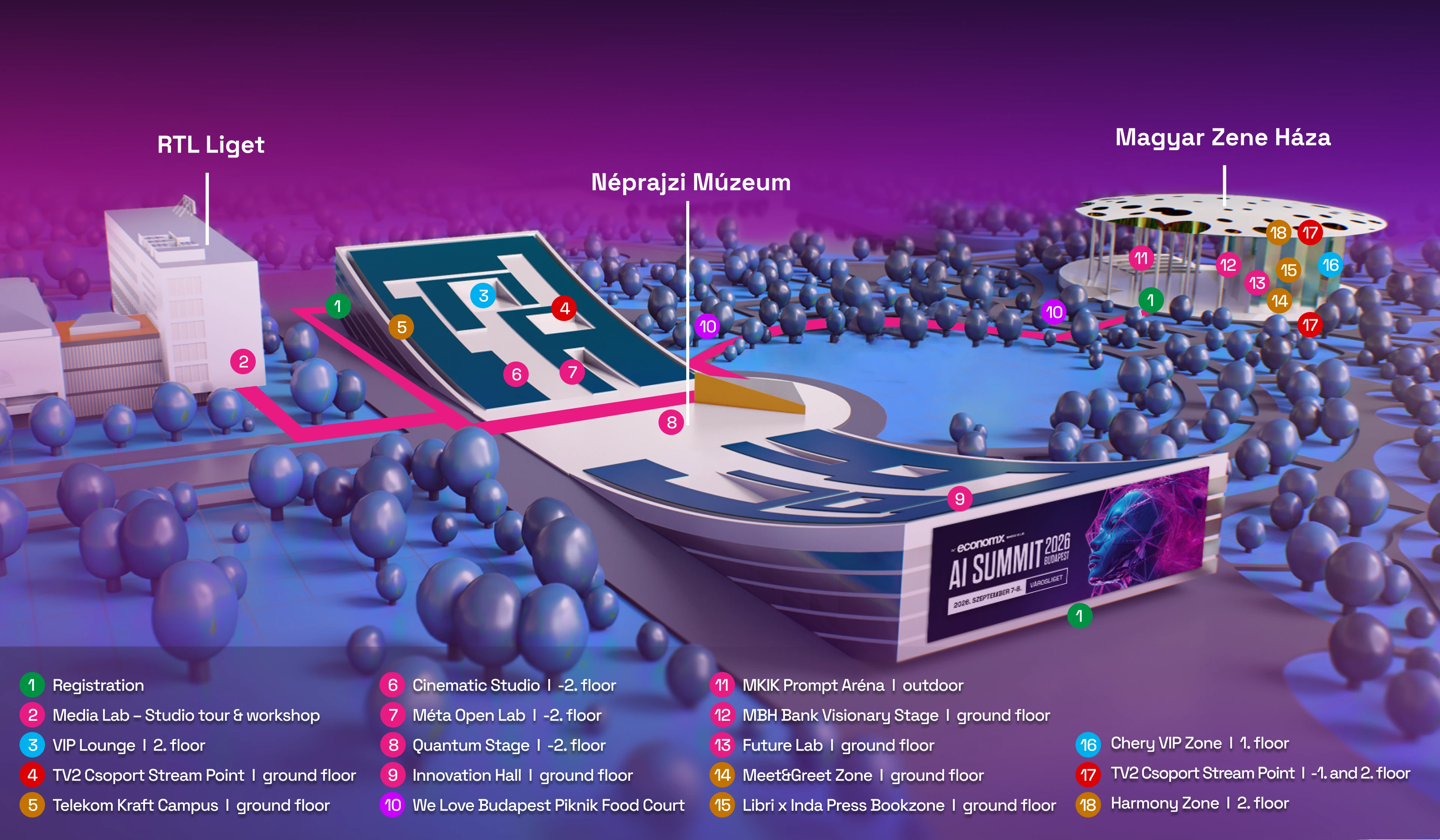
Three iconic Városliget venues transformed into a single connected campus: with stages, labs, networking zones, and VIP spaces.

AI Summit Campus 2026 map
01RTL Liget
Media Lab
02Néprajzi Múzeum
Cinematic StudioVIP LoungeMéta Open LabQuantum StageInnovation Hall
03Magyar Zene Háza
Prompt ArénaVisionary StageFuture LabVIP Zone
Featured programmes

Workshops and talks
from the world of AI

Full programme
Ambassadors

The AI Summit ambassadors

Bryony Cole (AU)

Bryony Cole (AU)

Founder

Future of Sex & Sextech School

Bryony Cole is a prominent voice at the forefront of global conversations about artificial intelligence and human intimacy. For more than a decade, she has examined how emerging technologies reshape relationships, identity, and emotional life, positioning her as one of the leading interpreters of technology’s impact on human connection.She is the founder of Future of Sex, a pioneering media and research platform exploring how technology transforms intimacy. Through its 10,500+ subscriber newsletter, top-ranked podcast that’s been downloaded 1 million times, and world-first accelerator in the sextech space, she has built a substantial international audience and sustained body of work examining what happens when technology enters our most intimate spaces.Her TED talk, “The AI-Generated Intimacy Crisis,” garnered almost 400,000 official TED plays and generated hundreds of public comments and significant international debate. Bryony’s insights have been featured in major international outlets including The New York Times, The Financial Times, Wired, Vogue, Fast Company, TechCrunch, and The Australian Financial Review. She has appeared on HBO and Netflix. She collaborates regularly with academic and research institutions including the Kinsey Institute, The New School, the University of Melbourne, and the University of Queensland, and has developed graduate-level curriculum on sexuality and technology at the California Institute of Integral Studies (CIIS).Her professional network spans government, industry, and academia, including founders and senior leaders shaping the future of artificial intelligence. This access provides her rare insight into how emotionally responsive AI systems are designed, deployed, and experienced.

Full profile
Nicolas Guyon (FR)

Nicolas Guyon (FR)

Founder & Host of Comptoir IA | AI Speaker & Trainer

Comptoir IA

Nicolas Guyon is one of France's most sought-after voices on generative AI. He created and hosts Comptoir IA - the first sponsored French-language podcast on AI, with 180 episodes - and is an official ambassador of France's national AI program, "Osez l'IA." A pioneer of live "vibe coding," he builds complete digital products - a full brand, an e-commerce store, a working app - from scratch, in real time, on stage. He has trained 250+ companies, including Microsoft, Google, L'Oréal and Hermès, on putting AI to work, and is a regular tech voice on BFM Business.

Full profile
George Tilesch

Dr. George Tilesch

Founder and President

PHI INSTITUTE for Augmented Intelligence

Dr. György Tilesch is a veteran global innovation and artificial intelligence (AI) expert, executive, advisor, and author, working primarily across the transatlantic region. For more than 25 years, he has served as a cross-industry strategist and bridge-builder between innovation and AI ecosystems worldwide, while advising senior leaders and decision-makers around the globe. With decades of international executive leadership and strategic consulting experience, Dr. Tilesch has worked with government leaders in the United States, the European Union, and Dubai, as well as with Microsoft, Ipsos, Fortune 50 technology companies, multinational corporations across a wide range of industries, international organizations, and leading global think tanks, including the World Economic Forum and the Club de Madrid. He has also collaborated extensively with startups, scaleups, and global social innovation leaders. His areas of expertise include the strategic, ethical, policy, and governance implications of artificial intelligence. Dr. Tilesch is the co-author of Between Brains: Taking Back Our AI Future, a book that explores how humanity can shape its future in the age of artificial intelligence. Based in Silicon Valley, he serves as a C-suite advisor, researcher, and guest lecturer at leading universities while traveling extensively to advance the mission of the PHI Institute: Using AI Well. He is a member of the Advisory Board of Harvard Experfy's AI Talent Platform, serves as the AI Ambassador of the John von Neumann Computer Society (Neumann Society), and, in addition to his legal background, has been awarded an honorary doctorate by his alma mater, the University of Pécs.

Full profile
Our Speakers

The people already
confirmed for this year

All speakers

Leiming Zeng

Senior Lead Solution Architect

Alibaba Cloud

Christian Eggers (DE)

President

Alibaba Cloud Europe Central Region

Ferenc Frész

CTO

CyEx Group

Dr. George Tilesch

Founder and President

PHI INSTITUTE for Augmented Intelligence

Dea Frankó-Csuba

founder, futurist

Spark Institut

Dr. Schum Kristóf

Generative AI Segment Leader, EMEA

Amazon Web Services

Kichan KANG, Ph.D. (KR)

Manager / Principal Researcher

Gyeonggi Smart Manufacturing Innovation Center, Gyeonggi Technopark (Republic of Korea)

Pál Bíró

country manager

Google Hungary

Kevin Kachidza (CA)

Founder & CEO

Sarafin AI & WorkPal Technologies

Balázs Szepesházi

Strategy&Operations Manager

Revolut

Prof dr Wim Vanhaverbeke (BE)

Professor Digital Strategy and Innovation

University of Antwerp at the Faculty of Business and Economics

Nicolas Guyon (FR)

Founder & Host of Comptoir IA | AI Speaker & Trainer

Comptoir IA

Krisztián Steigervald

generation researcher

Georgi Yankov (US)

Senior Scientist of Assessment Innovation

Hogan Assessments

Bryony Cole (AU)

Founder

Future of Sex & Sextech School

Leiming Zeng

Senior Lead Solution Architect

Alibaba Cloud

Christian Eggers (DE)

President

Alibaba Cloud Europe Central Region

Ferenc Frész

CTO

CyEx Group

Dr. George Tilesch

Founder and President

PHI INSTITUTE for Augmented Intelligence

Dea Frankó-Csuba

founder, futurist

Spark Institut

Dr. Schum Kristóf

Generative AI Segment Leader, EMEA

Amazon Web Services

Kichan KANG, Ph.D. (KR)

Manager / Principal Researcher

Gyeonggi Smart Manufacturing Innovation Center, Gyeonggi Technopark (Republic of Korea)

Pál Bíró

country manager

Google Hungary

Kevin Kachidza (CA)

Founder & CEO

Sarafin AI & WorkPal Technologies

Balázs Szepesházi

Strategy&Operations Manager

Revolut

Prof dr Wim Vanhaverbeke (BE)

Professor Digital Strategy and Innovation

University of Antwerp at the Faculty of Business and Economics

Nicolas Guyon (FR)

Founder & Host of Comptoir IA | AI Speaker & Trainer

Comptoir IA

Krisztián Steigervald

generation researcher

Georgi Yankov (US)

Senior Scientist of Assessment Innovation

Hogan Assessments

Bryony Cole (AU)

Founder

Future of Sex & Sextech School

Leiming Zeng

Senior Lead Solution Architect

Alibaba Cloud

Christian Eggers (DE)

President

Alibaba Cloud Europe Central Region

Ferenc Frész

CTO

CyEx Group

Dr. George Tilesch

Founder and President

PHI INSTITUTE for Augmented Intelligence

Dea Frankó-Csuba

founder, futurist

Spark Institut

Dr. Schum Kristóf

Generative AI Segment Leader, EMEA

Amazon Web Services

Kichan KANG, Ph.D. (KR)

Manager / Principal Researcher

Gyeonggi Smart Manufacturing Innovation Center, Gyeonggi Technopark (Republic of Korea)

Pál Bíró

country manager

Google Hungary

Kevin Kachidza (CA)

Founder & CEO

Sarafin AI & WorkPal Technologies

Balázs Szepesházi

Strategy&Operations Manager

Revolut

Prof dr Wim Vanhaverbeke (BE)

Professor Digital Strategy and Innovation

University of Antwerp at the Faculty of Business and Economics

Nicolas Guyon (FR)

Founder & Host of Comptoir IA | AI Speaker & Trainer

Comptoir IA

Krisztián Steigervald

generation researcher

Georgi Yankov (US)

Senior Scientist of Assessment Innovation

Hogan Assessments

Bryony Cole (AU)

Founder

Future of Sex & Sextech School

Tickets

Get your ticket
today!

One ticket, full access to both days: talks, workshops, and the AI Expo in one place. Prices do not include VAT.

Limited

Early Bird Ticket

128 000HUF
+27% VAT
  • Access to both event days
  • Talks, panel discussions, and keynote sessions
  • Workshops and practical sessions
  • Networking opportunities with AI and business professionals
  • Access to the AI Expo and partner activations
  • Food truck voucher
  • Event app access and access to session recordings
  • Free AI is NOW Bookazine
Buy ticket
Limited

VIP Ticket

238 000HUF
+27% VAT
  • Access to both event days with fast-track registration and priority access to stages
  • Talks, panel discussions, and keynote sessions
  • Workshops and practical sessions
  • Priority networking opportunities with AI and business professionals
  • Access to the AI Expo and partner activations
  • Event app access and access to session recordings
  • VIP networking lounge access
  • VIP catering
  • Exclusive programs and content
  • After AI Cocktail Party
  • Free AI is NOW Bookazine
Buy ticket
Group discount

More tickets, bigger savings, applied automatically in the cart.

-20%from 5 tickets
-25%from 10 tickets
-30%from 20 tickets
Payment options

At the end of the purchase you can pay by card or bank transfer. For bank transfers we automatically send a payment request. Please include the payment request number in the transfer note.

Special edition

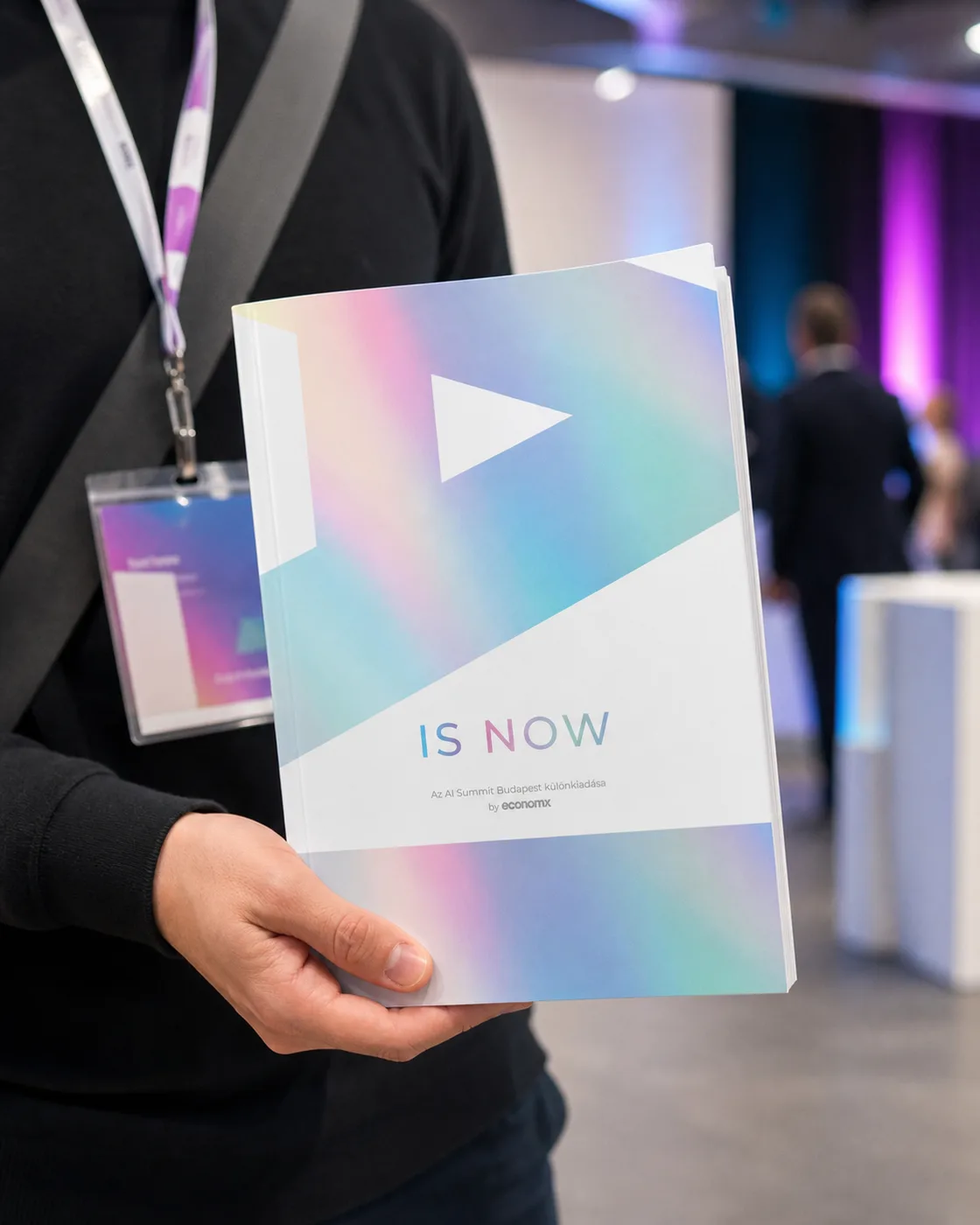
AI is NOW

The printed special edition of AI Summit Budapest 2026

For AI Summit Budapest 2026 we're publishing an exclusive edition of nearly 150 pages titled AI is NOW. It offers a comprehensive, accessible and professionally grounded picture of the economic, social and business impact of artificial intelligence. Inside you'll find interviews, in-depth articles and inspiring expert content – featuring the Summit's speakers and attendees, along with leading Hungarian and international experts in the field.

If you attend AI Summit Budapest 2026, you'll receive a complimentary copy of the AI is NOW bookazine with your ticket.

FAQ

Frequently asked questions

Didn't find your answer? Contact us at indaevents@indamedia.hu .

September 7–8, 2026 in Városliget, at the House of Music Hungary and the Museum of Ethnography buildings, as well as the outdoor AI Summit Campus zones.

Access to both days, all talks, panels, and keynotes, workshops and hands-on programmes, the AI expo, networking zones, a foodtruck voucher, and the event app with recorded sessions.

Yes. From 5 tickets: -20%, from 10 tickets: -25%, and from 20 tickets: -30%, automatically applied in the cart. Discounts cannot be combined.

Credit/debit card payment and bank transfer are both available at the end of the purchase process. For bank transfers, an automatic payment request is issued; please include its reference number in the transfer note.

Most talks are held in Hungarian, while international guests present in English; interpretation is provided on the main stages.

Fast-track entry, VIP lounge access and catering, exclusive programmes, and an invitation to the After AI Cocktail Party.

Newsletter · Economx Club

Don’t miss a thing

Club members are the first to be notified about the conference programme, new speakers, and exclusive ticket discounts.

We handle your data confidentially in line with our privacy policy. You can unsubscribe at any time.

Partners

Strong partners
stand behind us

Global partners

AWSGoogleAlibaba Cloud

Key sponsors

Adroit GroupMNBMBH Bank

Mobilitási partner

Chery

Sponsors

BDOTrendency

Media partners

TV2RTLATVIndexEconomxMediaFuturewelovebudapestradiocafeTrendfm

Akadémiai Partnerek

BMECorvinusSOTETsinghua EgyetemSzegedi Tudományegyetem
For speakers

Speak at AI Summit

Share your expertise with one of the region's largest AI audiences. Send us your talk idea and take the stage.

Apply to speak
For partners

Become a sponsor or exhibitor

Put your solution in front of thousands of decision-makers and professionals, live on site.

Get in touch